Unlock Optimal Oral Health: The Indispensable Role of Flossing for Healthy Gums and Fresh Breath
In the quest for a dazzling smile and vibrant oral health, many often overlook a simple yet profoundly effective tool: dental floss. As dental professionals, we consistently advocate for consistent flossing as a cornerstone of preventive oral care. It’s not just about removing visible food particles; flossing is the silent guardian against insidious plaque buildup, uncomfortable gum inflammation, and the embarrassment of persistent bad breath. Understanding its critical role and mastering the correct technique can fundamentally transform your oral hygiene routine, leading to healthier gums, stronger teeth, and a refreshing confidence that radiates from within.
Every day, our mouths are a bustling ecosystem of bacteria, saliva, and microscopic food remnants. While diligent brushing efficiently tackles the readily accessible top, front, and back surfaces of our teeth, it simply cannot reach into the tight, intricate spaces between teeth or adequately clean beneath the delicate gum line. These hidden crevices become prime breeding grounds for plaque – a sticky, colorless, biofilm teeming with harmful bacteria. If left undisturbed, this plaque rapidly hardens into tartar (calculus), a mineralized deposit that is impossible to remove with at-home brushing or flossing alone and necessitates professional dental cleaning.
This persistent accumulation of plaque and tartar continuously irritates the gum tissues, initiating inflammation known as gingivitis, characterized by redness, swelling, and bleeding during brushing or flossing. If gingivitis remains untreated, it can inexorably progress to more severe forms of gum disease, such as periodontitis, a condition that leads to irreversible bone loss supporting the teeth, gum recession, and, ultimately, tooth mobility and potential loss. Moreover, the anaerobic bacteria flourishing in these neglected areas are prolific producers of volatile sulfur compounds (VSCs), the primary culprits behind chronic bad breath, medically termed halitosis.
The Science Behind the Smile: How Flossing Works Its Magic
The fundamental purpose of flossing extends far beyond merely dislodging visible pieces of food. Its paramount objective is the mechanical disruption and meticulous removal of bacterial plaque from the interdental spaces and along the critical margin where the tooth meets the gum – areas where conventional toothbrush bristles, despite their best efforts, simply cannot effectively penetrate. Consider your teeth as having five distinct surfaces: the top (occlusal), front (buccal or labial), back (lingual or palatal), and the two vital side surfaces where they contact adjacent teeth (mesial and distal). A toothbrush is primarily designed to clean the top, front, and back surfaces. Flossing, conversely, is specifically engineered to meticulously clean those crucial interproximal surfaces, which astonishingly constitute approximately 35% of your tooth’s entire surface area.
When you engage in the act of flossing, you are physically scraping away the accumulating bacterial plaque before it has the opportunity to calcify and adhere firmly to your tooth enamel as tartar. This essential action not only directly prevents the insidious onset of gingivitis but also dramatically reduces the risk of interproximal cavities – decay that uniquely forms between adjacent teeth, often undetected until advanced. By consistently removing these tenacious bacterial colonies, flossing minimizes the production of those aforementioned volatile sulfur compounds, which are directly responsible for malodorous breath, thereby leaving your mouth feeling genuinely clean, refreshed, and invigorated.
Navigating the Floss Aisle: Choosing the Right Tool for Your Mouth
The contemporary world of dental floss offers a surprisingly diverse and extensive array of options, each thoughtfully designed to cater to various oral anatomies, individual preferences, and specific dental needs. Finding a floss product that feels both comfortable and effortlessly easy to use is absolutely paramount, as unwavering consistency in practice is exponentially more important than the specific type of floss employed. We strongly encourage a period of experimentation to discover precisely what works best for your unique oral landscape, thereby ensuring that flossing seamlessly integrates into your daily routine as an enjoyable and effortless habit, rather than an unappealing chore.
- Waxed vs. Unwaxed Floss: Waxed floss is frequently the preferred choice for individuals who possess particularly tight contact points between their teeth, as the subtle wax coating allows it to glide more smoothly and with less friction, significantly reducing the likelihood of shredding or snagging. Unwaxed floss, while occasionally prone to shredding in very tight spaces, is favored by some for providing a distinctively “squeaky clean” sensation, as its slightly thinner, unlubricated strands can sometimes navigate exceptionally narrow crevices more intimately.
- Floss Tape or Ribbon: Characteristically wider and flatter in profile than traditional string floss, tape floss is an excellent choice for individuals who have naturally larger gaps between their teeth, broader tooth surfaces, or specific dental work that creates wider interdental spaces. Its increased surface area allows for more efficient cleaning in these specific anatomical configurations.
- PTFE (Polytetrafluoroethylene) Floss: Often marketed under descriptors such as “gliding” or “comfort” floss, PTFE floss is expertly crafted from a single, robust filament, conceptually similar to the advanced material used in Gore-Tex fabric. Its remarkably slippery and smooth texture makes it extraordinarily easy to slide effortlessly between teeth, even within the most constrictive spaces, and it exhibits superior resistance to shredding. This particular type can be an exceptionally wise choice for beginners who are developing their flossing technique or for anyone who finds traditional multi-filament floss challenging to maneuver.
- Floss Picks (Single-Use Flossers): These incredibly convenient tools feature a small, pre-strung segment of floss tensioned on a compact plastic handle. While undeniably excellent for on-the-go cleaning, incredibly beneficial for children, or for individuals with limited manual dexterity, they may not consistently allow for the same comprehensive “C-shape” contouring and wrapping around each individual tooth that traditional string floss expertly provides. However, their sheer ease of use can dramatically increase daily compliance for a vast number of people.
- Interdental Brushes: For individuals with noticeably larger spaces between their teeth, those experiencing gum recession, or patients with orthodontic braces, fixed bridges, or dental implants, interdental brushes can prove to be astonishingly effective. Available in a vast spectrum of sizes and shapes, these tiny, specialized brushes are ingeniously designed to clean between teeth and thoroughly around various dental appliances with unparalleled efficiency, often surpassing the capabilities of floss alone in these specific scenarios.
- Water Flossers (Oral Irrigators): While it is crucial to understand that water flossers are not a direct replacement for the mechanical plaque removal achieved by traditional string floss or interdental brushes, they can serve as an exceptionally valuable adjunct to your overall oral hygiene regimen. These devices utilize a focused stream of pulsating water to dislodge and rinse away food particles and loose plaque from between teeth and gently beneath the gum line. They are particularly beneficial for those with orthodontic appliances, non-removable bridges, crowns, or implants, and for individuals who experience significant difficulty with or discomfort from traditional mechanical flossing. However, for the tenacious removal of sticky, adherent plaque, string floss or interdental brushes generally remain superior.
The ultimate and overarching goal, irrespective of your chosen tool, is unwavering consistency. Select the floss that empowers you to floss daily without undue struggle, discomfort, or frustration. If you find yourself uncertain about which type of floss is best suited for your unique dental architecture and specific needs, please do not hesitate to consult your trusted dentist or skilled dental hygienist; they possess the expertise to provide personalized recommendations based upon a thorough assessment of your individual oral health.
Mastering the Art of Flossing: A Step-by-Step Guide to Floss Like a Boss
Effective flossing transcends the mere act of moving a piece of string between your teeth; it necessitates the employment of a precise and deliberate technique that is specifically designed to maximize plaque removal while concurrently safeguarding your delicate gum tissues from injury. Adopting and consistently practicing the correct method ensures that you fully reap the profound benefits of this essential oral hygiene practice.
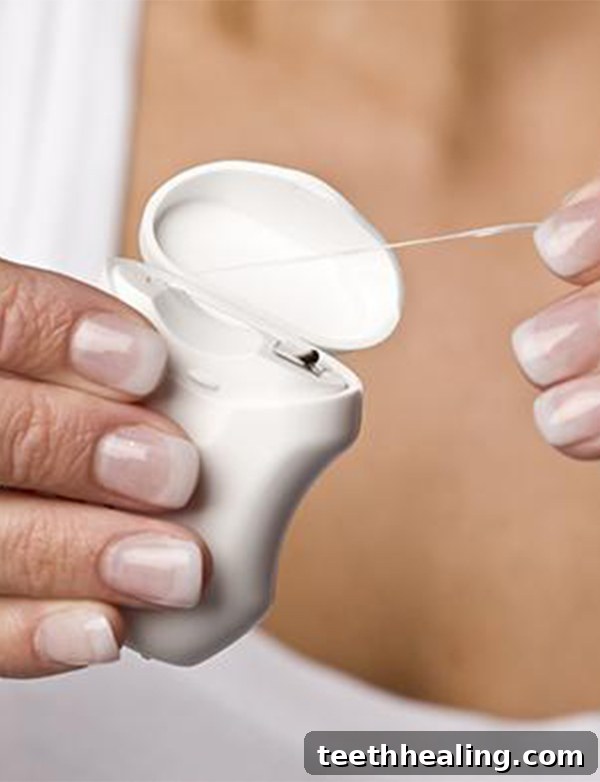
- Prepare Your Floss: Initiate the process with a generous segment of dental floss, approximately 18 inches (or 45 centimeters) in length. This ample length is critical as it ensures you will have a fresh, unused section of floss readily available for each individual tooth, thereby effectively preventing the undesirable transfer of bacteria from one cleaned area to another. Carefully wind the majority of the floss around the middle fingers of both hands, leaving a manageable working length of about 1 to 2 inches (2.5 to 5 cm) held tautly between your thumbs and index fingers. This short, controlled working length provides optimal precision and maneuverability.
- Guide with Precision: Gently guide the floss between two adjacent teeth using a soft, controlled, saw-like, or delicate rocking motion. It is absolutely crucial to avoid aggressively “snapping” the floss down against your gums, as this forceful action can easily injure your gum tissues, causing unnecessary discomfort, trauma, or bleeding. The primary objective is to ease the floss smoothly and deliberately through the contact point until it comfortably reaches the gum line.
- Form the “C” Shape: Once the floss has successfully reached the gum line, gently curve it into a distinct “C” shape, ensuring it snugly wraps around one side of the tooth’s surface. This meticulously sculpted contouring allows the floss to achieve maximum surface contact with the tooth enamel and to slide ever so slightly, approximately 1-2 millimeters, beneath the gum line, effectively dislodging hidden plaque and stubborn food debris that brushing alone cannot reach.
- Clean Each Surface: Maintaining a firm yet gentle grip on the floss, carefully slide it up and down along the tooth surface several times. It is imperative to ensure that you extend the floss a little below the gum line – always gently and without forcing it or causing any pain. This precise, systematic motion efficiently scrapes away adherent bacterial plaque.
- Repeat for Both Sides: After thoroughly cleaning one side of the tooth, gently bring the floss upward and out from between the teeth. Subsequently, carefully reposition the floss to engage the surface of the adjacent tooth, and repeat the distinct “C” shape and the meticulous up-and-down cleaning motion on its surface. It is critically important to clean both individual surfaces within each interdental space.
- Advance to a Clean Section: As you progressively move from one tooth to the next, systematically unroll a fresh, clean section of floss from one middle finger while simultaneously winding the used, plaque-laden section onto the other middle finger. This rigorous practice ensures that you are consistently utilizing a pristine portion of floss, thereby preventing the reintroduction of bacteria to other, already cleaned areas of your mouth.
- Address All Teeth: Do not neglect the crucial back surfaces of your rearmost molars. Carefully maneuver the floss behind these teeth, curving the floss around their posterior surfaces with the same diligence and technique applied to the interdental spaces.
- Rinse and Follow Up: Upon completing the meticulous flossing of all your teeth, rinse your mouth thoroughly with water to effectively wash away any loosened food particles and dislodged plaque. Following this, proceed with brushing your teeth, allowing your toothbrush to further clean accessible surfaces and to effectively distribute vital fluoride throughout your oral cavity.
Consistency, above all else, is the undisputed key to successful flossing. While ideally, flossing twice a day before brushing is optimal for superior plaque removal, committing to flossing at least once a day, preferably just before retiring for bed, is demonstrably sufficient and exceptionally beneficial. Flossing prior to sleep ensures that accumulated plaque and microscopic food particles do not linger in your mouth throughout the night, a prolonged period during which harmful bacteria can proliferate unchecked and exert their damaging effects on your teeth and gums.
Developing true proficiency in flossing is an acquired skill that requires dedicated practice and unwavering perseverance. Do not become discouraged if the process feels awkward or cumbersome during your initial attempts. Begin by focusing on the easier-to-reach front teeth to build your confidence and refine your technique, perhaps utilizing a mirror to visually guide and perfect your movements. With consistent and deliberate effort, you will very quickly discover that even the seemingly harder-to-reach back teeth become manageable, and the entire flossing process will soon occupy only a few short, efficient minutes of your daily routine.
Beyond Aesthetics: The Profound Benefits of Daily Flossing
The myriad advantages of regular, meticulous flossing extend far beyond merely preventing the occasional bout of bad breath. It stands as an absolutely vital component of a comprehensive and proactive oral care routine that contributes significantly to both your immediate oral comfort and your long-term systemic health.
- Prevents Gum Disease: By meticulously removing bacterial plaque from below the gum line, flossing directly and powerfully combats gingivitis – the initial and reversible stage of gum disease. This proactive measure prevents its insidious progression to more severe and irreversible conditions such as periodontitis, which can tragically lead to bone loss, receding gums, and ultimately, premature tooth loss.
- Fights Halitosis (Bad Breath): The primary and most common cause of chronic bad breath is the accumulation of offensive odor-producing bacteria and decaying food particles within the oral cavity, particularly ensconced within the hard-to-reach interdental spaces. Consistent flossing effectively removes these primary culprits, leaving your breath consistently fresh, clean, and truly inviting.
- Reduces Risk of Tooth Decay: A significant proportion of dental cavities do not form on the readily visible chewing surfaces of teeth, but rather occur insidiously between them, precisely where bacterial plaque can sit undisturbed and generate destructive acids. Flossing regularly dislodges this aggressive plaque, dramatically reducing your susceptibility to interproximal cavities and the subsequent need for restorative dental fillings.
- Promotes Overall Systemic Health: A constantly evolving body of scientific research continues to highlight the intricate and undeniable connection between optimal oral health and overall systemic well-being. The chronic inflammation and widespread bacterial presence associated with advanced gum disease have been increasingly linked to an elevated risk or exacerbation of various serious systemic conditions, including cardiovascular disease, diabetes mellitus, and certain respiratory issues. Thus, maintaining a healthy mouth demonstrably contributes to fostering a healthier body.
- Enhances Smile Aesthetics and Confidence: Genuinely healthy gums are characterized by their firm, pink appearance and a complete absence of bleeding. Consistent and effective flossing diligently helps maintain this healthy and aesthetically pleasing appearance, preventing the unattractive swelling, redness, or recession of gums that can significantly detract from the natural beauty of your smile. A clean, healthy, and vibrant mouth inherently leads to greater self-confidence in all social and professional interactions.
Addressing Common Flossing Queries and Challenges
Despite its widely acknowledged and proven benefits, the practice of flossing occasionally faces resistance or abandonment due to common misconceptions, initial difficulties, or lingering anxieties. Let’s proactively address some of these frequently encountered queries and challenges:
- “My Gums Bleed When I Floss”: This is an incredibly common initial experience and, somewhat paradoxically, it is often a definitive sign that you unequivocally need to floss more diligently, rather than less. Bleeding gums are a classic indicator of inflammation (gingivitis), which is almost universally caused by the accumulation of bacterial plaque. With consistent, gentle, and proper flossing over a period of just one to two weeks, the underlying inflammation should predictably subside, and the bleeding will, in all likelihood, cease. However, if bleeding persists stubbornly or appears excessively heavy, it is absolutely essential to consult your dentist, as it could signal a more serious underlying oral health issue that requires professional attention.
- “Flossing is Too Time-Consuming”: Once the technique is mastered and becomes an ingrained habit, effective and comprehensive flossing typically requires only 1-2 minutes of your time each day. When this minimal daily investment is weighed against the substantial potential costs, discomfort, and long-term health implications of untreated cavities, advanced gum disease treatment, or the irreversible loss of teeth, this small temporal commitment is unequivocally and profoundly worthwhile.
- “I Can’t Get the Floss Between My Teeth”: If the spaces between your teeth are exceptionally tight or present significant difficulty, consider switching to waxed floss, specialized PTFE floss, or utilizing a floss threader (which is particularly helpful for navigating around fixed bridges or braces). For individuals with naturally larger gaps, the use of interdental brushes in appropriate sizes can be remarkably effective. Your dentist can also meticulously examine your oral anatomy to identify if there are any specific structural reasons contributing to your difficulty and offer tailored solutions.
- “Brushing Is Enough”: This constitutes a pervasive and dangerously misleading myth. As extensively discussed, a conventional toothbrush, regardless of its design or sophistication, simply cannot effectively clean between the teeth or adequately reach beneath the gum line where plaque thrives. Brushing and flossing are distinct yet perfectly complementary components of a comprehensive oral hygiene strategy; one cannot, under any circumstances, fully replace the other for truly thorough and preventive cleaning.
The Synergy of Oral Care: Flossing as Part of a Complete Routine
While flossing stands as an undeniable powerhouse for meticulous interdental cleaning, it represents just one crucial pillar within a truly holistic and highly effective oral hygiene strategy. For the attainment of genuinely healthy teeth and gums, persistently fresh, clean breath, and a radiant smile you can confidently share with the world, it is absolutely imperative that you seamlessly integrate flossing with other equally essential practices:
- Consistent Brushing: Brush your teeth meticulously twice a day, for a minimum duration of two minutes each time, utilizing a fluoride-containing toothpaste. This practice effectively cleans the main surfaces of your teeth and delivers vital fluoride minerals to strengthen your tooth enamel against decay.
- Regular Dental Check-ups and Professional Cleanings: No amount of diligent at-home care, no matter how thorough, can completely remove hardened tartar (calculus). Biannual visits to your trusted dentist and skilled dental hygienist are indispensable for professional cleaning to meticulously remove stubborn tartar, detect the earliest signs of decay or gum disease, and provide you with personalized, expert advice.
- Healthy Diet: Consciously limit your intake of sugary snacks and acidic drinks, which actively feed plaque bacteria and contribute significantly to destructive acid attacks on your tooth enamel. Instead, opt for a balanced, nutrient-rich diet abundant in fresh fruits, vibrant vegetables, and wholesome whole grains.
- Mouthwash (Optional, but Beneficial): While it is crucial to understand that mouthwash is never a substitute for the mechanical cleaning action of brushing and flossing, an antimicrobial or fluoride mouthwash can provide an additional layer of protection, particularly if specifically recommended by your dentist for targeted concerns such as excessive plaque, gingivitis, or high cavity risk.
Embracing and consistently adhering to these integrated habits ensures a robust and resilient defense against the most common oral health challenges, thereby promoting not only a strikingly beautiful and healthy smile but also contributing profoundly and positively to your overall systemic well-being and quality of life.
If it’s been 6 months or more since your last dental visit, if you’re experiencing persistent bleeding gums, uncomfortable sensitivity, or have any concerns whatsoever about your dental health, please do not hesitate to contact us today. Our dedicated and compassionate team is here to provide expert care, comprehensive guidance, and tailored treatment plans designed specifically for you. Call us now at 07 3720 1811 to schedule your essential appointment and take the next step towards optimal oral health.