Welcome to the future of dental care! Modern dentistry is no longer just about fixing problems; it’s about prevention, comfort, precision, and aesthetics. Breakthroughs in dental technology have transformed the patient experience, making treatments more effective, less invasive, and surprisingly comfortable. If it’s been a while since your last dental visit, you’re in for a pleasant surprise. The advancements we see today offer incredible solutions to keep your teeth healthy, strong, and beautiful for a lifetime.
This article explores the cutting-edge technologies that are reshaping dentistry, providing both patients and practitioners with unparalleled tools for diagnosis, treatment, and long-term oral health. From detecting cavities before they cause pain to replacing missing teeth with remarkable success rates, modern dental practices are equipped to deliver a level of care that was once unimaginable. Let’s delve into how these innovations are improving dental treatments and enhancing overall patient well-being.
Revolutionizing Dental Care: Key Technological Advancements in Modern Dentistry
The core mission of modern dental technology is to elevate the standard of patient care. This means offering leading-edge treatments that are not only highly effective but also more efficient and comfortable. Many dental clinics proudly showcase their state-of-the-art equipment, and for good reason. These innovations tackle traditional dental challenges with sophisticated solutions, turning potentially daunting procedures into routine, stress-free experiences. Here’s a closer look at some of the most impactful technologies shaping today’s dental landscape.
Enhanced Detection and Treatment of Dental Decay
Early detection and minimally invasive treatment are cornerstones of modern dentistry. New technologies allow dentists to identify and address tooth decay at its earliest stages, often before it becomes a noticeable problem. This approach helps preserve more of your natural tooth structure and prevents the need for more extensive procedures down the line.
Diagnodent: Pinpointing Hidden Cavities
Diagnodent is a groundbreaking device that offers a precise way to detect early cavities, even those hidden from traditional X-rays. This small, portable tool utilizes sound pulses and laser technology to scan tooth surfaces. It’s particularly effective at identifying decay in occlusal grooves and pits on the biting surfaces of your teeth, areas where cavities often begin but are difficult to spot visually or with conventional methods.
The high accuracy of Diagnodent means that decay can be diagnosed significantly earlier. This allows for immediate, minimally invasive treatment, limiting the progression of the decay and maximizing the preservation of your healthy tooth structure. Early intervention often translates to simpler, less costly, and more comfortable treatments.
Air Abrasion: A Gentle Alternative to the Drill
For patients who dread the sound and sensation of a traditional dental drill, air abrasion offers a welcome alternative. This innovative system is primarily used for treating small cavities, but it’s also effective for repairing old tooth restorations or gently removing superficial stains and discolouration.
During an air abrasion procedure, a fine stream of particles, typically consisting of air and aluminum oxide, is directed at the affected portion of the tooth. Propelled by compressed air, this mixture gently removes small particles of decay or stain from the tooth surface, which are then suctioned away. A key advantage of air abrasion is that it generates no heat, pressure, or vibration, significantly reducing or even eliminating the need for local anaesthesia. This preserves more of the tooth’s healthy structure and makes the experience much more comfortable. Safety precautions are minimal, usually just requiring protective eyewear and sometimes a rubber dam to protect surrounding tissues.
Dental Microscope: Precision at a Micro-Level
The dental microscope has become an invaluable tool, significantly enhancing a dentist’s ability to diagnose and treat with unparalleled precision. It provides dentists with magnified views, allowing them to visualize micro-cracks, assess weakened underlying tooth structures, and accurately determine the proximity of dental nerves. This level of detail is crucial for meticulous work.
Beyond cavity treatment, where it ensures maximum healthy tooth preservation, the microscope is a superior diagnostic aid and a powerful treatment assistant. It’s successfully integrated into complex procedures like Endodontics (root canal therapy) and Oral Surgery, where accuracy can directly impact treatment success and patient outcomes.
Advanced Composite Materials: Aesthetic and Durable Fillings
Gone are the days when dental fillings meant noticeable silver amalgam. Modern composite resin materials, commonly known as tooth-coloured fillings, have undergone continuous improvement. They are now highly refined to precisely replicate natural tooth colours, are easier for dentists to apply, and offer impressive durability.
These composite materials offer significant advantages over older technologies like gold or amalgam. Their ability to blend seamlessly with your natural tooth colour provides beautiful, natural-looking results, thanks to their translucent qualities. Composite resins rely on advanced bonding techniques and are versatile, used in a wide range of restorations including fillings, veneers, inlays, onlays, and even some dental crowns or bridges. This allows for conservative yet highly aesthetic and functional repairs.
Advanced Dental Implant Solutions: Restoring Your Smile with Confidence
Dental implants represent the pinnacle of tooth replacement technology. Once considered a niche treatment, they are now a common and highly successful solution for missing teeth. Significant advancements have boosted their typical lifespan to 15 years or longer, with success rates hovering around an impressive 95%. This incredible reliability is due to continuous innovation in materials, surgical techniques, and diagnostic planning.
The field of implantology continues to evolve, with innovations like mini-implants that accommodate smaller tooth replacements and techniques allowing for immediate implant placement after tooth extraction, reducing overall treatment time. Here are some modern technologies that further enhance the precision and success of dental implant treatments:
CT Scan: Precision Planning for Implants
Computed Tomography (CT) scans, or CAT scans, have become an indispensable tool in the precise planning and placement of dental implants. A CT scan uses specialized X-ray technology to create detailed cross-sectional images of the body. In dentistry, modern CT scan software renders high-quality, complex three-dimensional images of the jawbone and surrounding structures.
This advanced imaging allows dentists to accurately assess bone quantity and quality, crucial factors for implant success. Before any surgical intervention, the CT scanning software enables virtual placement of dental implants on a computer program. This virtual planning minimizes potential manual placement errors and ensures that the implant position perfectly aligns with the prosthetic requirements of the final restoration, leading to predictable and optimal outcomes.
Cone-Beam Computed Tomography (CBCT): Focused 3D Imaging
Building on the principles of traditional CT, Cone-Beam Computed Tomography (CBCT) offers a more compact, faster, and safer imaging solution specifically tailored for dental applications. By utilizing a cone-shaped X-ray beam, CBCT dramatically reduces the size of the scanner, the radiation dosage exposure, and the time required for a scan.
CBCT generates high-resolution 3D images, providing dentists with comprehensive views of oral structures from multiple vantage points. It reveals not only the height but also the width of bone, critical for implant planning. Furthermore, CBCT scans can identify important anatomical features such as cysts, impacted teeth, and the precise location of nerves and arteries, which might complicate implant placement. This detailed insight allows dentists to mitigate risks and plan even the most challenging implant cases with confidence.
Safer, Faster Diagnostics: The Power of Digital X-Rays
Digital X-rays have largely replaced traditional film-based radiographs, offering a multitude of benefits for both patients and practitioners. This modern dental imaging technique is significantly faster, producing images almost instantly, and crucially, exposes patients to up to 90% less radiation compared to conventional X-rays.
The process is more comfortable, as images are captured via a small sensor placed in the mouth and processed directly onto a computer screen within seconds. This immediacy allows dentists to quickly identify problems with teeth, the mouth, and the jaw. Furthermore, digital images can be enhanced with computer software, enabling the dentist to zoom in, adjust contrast, and perform various measurements, leading to more accurate diagnoses and better treatment planning. The reduced radiation exposure is a major health advantage, making routine check-ups safer than ever.
Seeing is Believing: Enhancing Patient Education with Intraoral Cameras
The intraoral camera is a compact, lightweight tool that brings a new dimension to dental examinations. It captures accurate, high-resolution images of the teeth and their supporting structures, including areas that are difficult to see with the naked eye. This technology allows dentists to conduct exceptionally thorough check-ups and gain a precise understanding of a patient’s oral care needs.
One of the most powerful features of the intraoral camera is its ability to display these images on a screen for the patient to see. This visual aid is invaluable for patient education, enabling dentists to clearly demonstrate specific issues like decay, cracks, or gum disease. By seeing what the dentist sees, patients can better understand their diagnosis, treatment options, and the importance of recommended care, fostering greater trust and engagement in their oral health journey.
Say Goodbye to Messy Impressions: The Precision of Intraoral Scanners
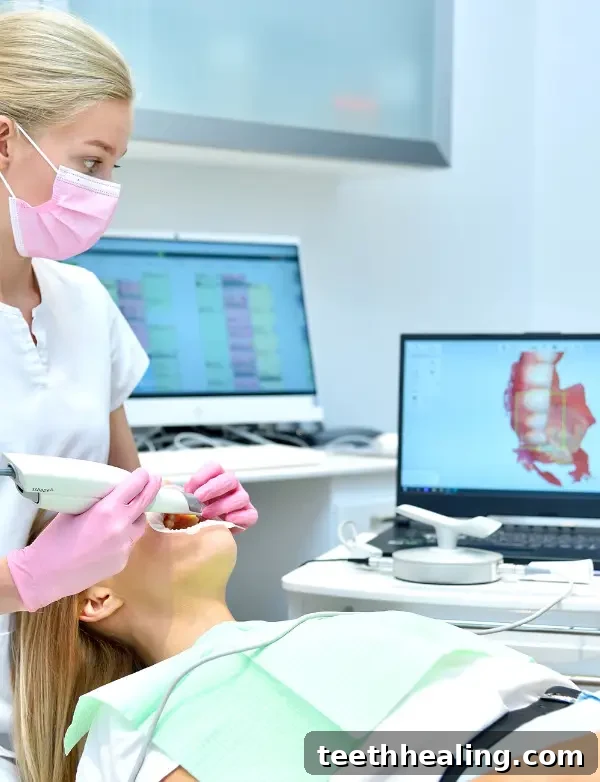
The era of gooey, uncomfortable dental impressions is rapidly becoming a thing of the past, thanks to the advent of digital or intraoral scanners. When preparing a tooth for a crown, inlay, veneer, or even orthodontics, dentists can now use a small, handheld intraoral scanner to create a highly accurate digital impression.
This technology eliminates the need for messy impression materials, making the experience much more pleasant for patients. The digital impression is instantly sent to specialized design software, where the dentist or dental technician can meticulously construct the designed tooth restoration on a screen. Intraoral scanners are also widely used in orthodontics for planning treatments, and for creating precise digital maps of the tooth and surrounding structures to fabricate whitening trays, nightguards, and sleep apnea appliances. They also assist in accurate colour analysis for cosmetic restorations made in a dental laboratory, ensuring a perfect match.
Revolutionizing Treatment with Dental Laser Technology
Dental lasers utilize focused light energy to perform a wide array of dental procedures, offering significant advantages such as reduced discomfort, minimized bleeding, and a remarkably shortened healing period. This versatile technology has transformed many aspects of dental care, enhancing both efficiency and patient comfort.
The application of dental lasers varies depending on the procedure:
- Surgical and Cavity Preparation: For surgical procedures or preparing a tooth for a filling, the laser acts as an incredibly precise cutting instrument or a tissue vaporizer, minimizing trauma to surrounding areas.
- Cavity Detection: When used for early cavity detection, decayed teeth respond to specific wavelengths of a diode laser by glowing differently than healthy tooth structure, allowing for higher readings on a display and revealing hidden decay.
- Curing Fillings: Lasers can also be employed to “cure” composite fillings, strengthening the bond between the filling material and the tooth structure for enhanced durability.
- Teeth Whitening: In teeth whitening procedures, the laser acts as a controlled heat source, accelerating and enhancing the effect of professional whitening agents, leading to brighter results in less time.
Beyond these, lasers are also used for reducing tooth sensitivity, treating benign tumours and cold sores, reshaping gummy smiles, and performing crown lengthening procedures, highlighting their broad spectrum of benefits in a modern dental practice.
Precision Craftsmanship: The Benefits of CAD/CAM Dental Restorations
CAD/CAM technology, an acronym for Computer-Assisted Design and Computer-Assisted Manufacture, represents a significant leap forward in the fabrication of dental restorations. This sophisticated computerized technology allows for the precise design and creation of a vast range of dental prosthetics directly in the dental office or laboratory.
CAD/CAM systems are utilized to improve the design and creation of numerous dental restorations, including highly customized crowns, veneers, inlays and onlays, fixed bridges, dental implant restorations, durable zirconia frames, complete and partial dentures, and even orthodontic appliances. The technology ensures unparalleled accuracy, an excellent fit, and often, the ability to complete restorations in a single visit, saving patients time and multiple appointments while delivering superior quality and aesthetics.
Modern Root Canal Therapy: Enhanced Precision and Patient Comfort
Root canal therapy, or endodontic treatment, involves a series of procedures designed to clean, shape, and decontaminate the root canals of an infected or damaged tooth. Traditionally, these operations were performed manually using a variable number of endodontic files. However, modern endodontics has been revolutionized by a wide variety of electronic systems that significantly improve accuracy, safety, and patient outcomes.
These advanced systems offer crucial advantages, allowing dentists to monitor the root canal before, during, and after instrumentation. Rotary systems, for instance, prepare root canals at a low, controlled speed using specific hand-pieces, minimizing stress on the tooth. The shaping and cleaning of root canals are performed while continuously monitoring the position of the files inside the canal, preventing common complications. A key component of these systems is the electronic apex locator, a device used to precisely determine the position of the apex (the tip of the tooth root) and thus the exact length of the root canal space. The position of the files and detailed information about the length and shape of the root canals are displayed on a screen, providing real-time guidance and ensuring a thorough and safe treatment.
Experience Anxiety-Free Dentistry: Innovations for Painless Procedures
One of the most common reasons patients avoid dental visits is the fear of pain, particularly the discomfort associated with needles and injections. The good news is that modern dentistry has made tremendous strides in creating truly painless and anxiety-free experiences. Dentists are increasingly adopting new equipment and techniques designed to make dental treatment and anaesthesia an acceptable, normal part of life, transforming the patient’s perception of dental care.
The Wand: Gentle, Computer-Controlled Anaesthesia
The Wand is an exemplary innovation in painless dentistry. It’s a computerized anaesthesia delivery system that allows the dentist to administer local anaesthesia in a slow, precise, and methodical manner. The gentle, controlled flow of anaesthetic, combined with a small, pen-like delivery holder, often makes injections virtually painless. Patients frequently report feeling little to no discomfort, especially when compared to traditional syringe injections. This comfortable experience helps alleviate anxiety, making dental appointments more manageable and less stressful for everyone.
Early Detection Saves Lives: Advanced Oral Cancer Screening
Early detection is paramount in successfully treating oral cancer. Modern dental practices are equipped with advanced screening tools that allow dentists to identify suspicious lesions or abnormalities at their earliest, most treatable stages, often before they become visible to the naked eye or cause any symptoms.
OralID: Illuminating Early Signs of Oral Cancer
OralID is a state-of-the-art oral cancer screening system that utilizes specialized incandescent light technology. This light helps your dentist visualize abnormalities that might otherwise be imperceptible or not yet visible during a standard visual examination. By highlighting changes in oral tissue, OralID provides an effective method for detecting early forms of cancer or precancerous conditions. Regular screenings with such advanced technology can significantly improve outcomes by allowing for timely intervention.
Invisible Orthodontics: Achieving Your Dream Smile with Clear Aligners
Orthodontic treatment has also seen remarkable advancements, moving beyond traditional metal braces. Clear aligners, such as the popular Invisalign system, offer an aesthetic and convenient alternative for straightening teeth. While traditional braces remain essential for certain complex cases, clear aligners are highly effective for over 80% of common orthodontic issues.
Invisalign, along with other advanced clear aligner brands like Spark, consists of a series of clear, custom-made, removable aligners. Each set of aligners is worn for approximately one week before being replaced with the next in the series. As patients progress through the aligner sets, their teeth gradually and gently shift into their projected final position, delivering a straighter, more confident smile without the aesthetic impact of traditional braces. The removability of aligners also allows for easier eating and oral hygiene.
The landscape of modern dentistry is continuously evolving, driven by an unwavering commitment to patient comfort, efficiency, and exceptional treatment outcomes. These technological marvels, combined with the timeless values of compassionate care, redefine what it means to visit the dentist.
Evolve Dental Holistic Dentist Brisbane – Embracing Modern Dentistry with Care
At Evolve Dental Holistic Dentist Brisbane, we are proud to integrate these modern dental advancements with our core values of holistic care and personalized patient attention. Our practice is dedicated to leveraging the latest technology to ensure your treatments are as effective, comfortable, and efficient as possible, always prioritizing your overall health and well-being.
Experience modern dentistry where leading-edge treatments meet good old-fashioned values and care. To discover how our advanced approach can benefit your smile and oral health, please don’t hesitate to call us today at 07 3720 1811.
Alternatively, you can conveniently BOOK AN APPOINTMENT ONLINE through our website.